
ODOC Releases Serving Cotton County
The Oklahoma Department of Corrections is a statewide system of reception, prisons, community corrections, records, and supervision offices. It is not the Cotton County Jail. No active ODOC prison was verified inside Cotton County. Current ODOC facility materials also conflict with stale references to a Walters Community Work Center, so that name should not be treated as an active prison without direct agency confirmation.
ODOC becomes the controlling custody source when a Cotton County court sentence sends a person into state corrections. Disappearance from the county jail may mark transfer to ODOC reception, not release to the community. Later, an ODOC record can show parole, discharge, transfer, death, or rebill. Each label has a different legal and physical meaning. The destination and source record decide whether a person left government custody, moved within it, or began supervision.
| ODOC event | What it means | Best follow-up record |
|---|---|---|
| Paroled | Conditional community release with continued supervision | CRC notation, Certificate, and assigned P&P office |
| Discharge | Recorded termination of the state sentence component shown | Certificate of Release and CRC termination entry |
| Transfer | Movement to another placement or authority | Movement history and destination |
| Rebill | A new record card begins for a consecutive case | CRC entries and Judgment and Sentence |
| Death | Custody ends for a reason that is not release | Literal CRC notation and agency record |
Note: A Cotton County jail departure becomes an ODOC release question only when the sentence or transfer record shows state custody.
Confirm an ODOC Release
Begin with the official ODOC offender lookup. Search by ODOC number when it is known. A name search requires close comparison with the sentence and other lawful identity details. ODOC warns that its public data is abbreviated and is not an exact explanation of the offense, sentence, or time served. The interface has also carried a warning about issues after a data-source change. Preserve a dated result as a lead, not as a certified record.
- Classify the custody. Confirm that the Cotton County case actually led to ODOC rather than local, federal, tribal, juvenile, or immigration custody.
- Search by ODOC number. If only a name is known, compare all displayed identifiers and sentence lines before selecting a result.
- Record the exact label. Note whether the history indicates active custody, parole, discharge, transfer, or another state.
- Trace the destination. A transfer or rebill is not community release. Follow the movement or consecutive case.
- Request formal records. Ask for the public Certificate of Release, CRC termination entries, and relevant movement history.
The ODOC statewide search screen is shown in the successful manifest capture below. It is the correct starting interface for a state corrections record tied to Cotton County.
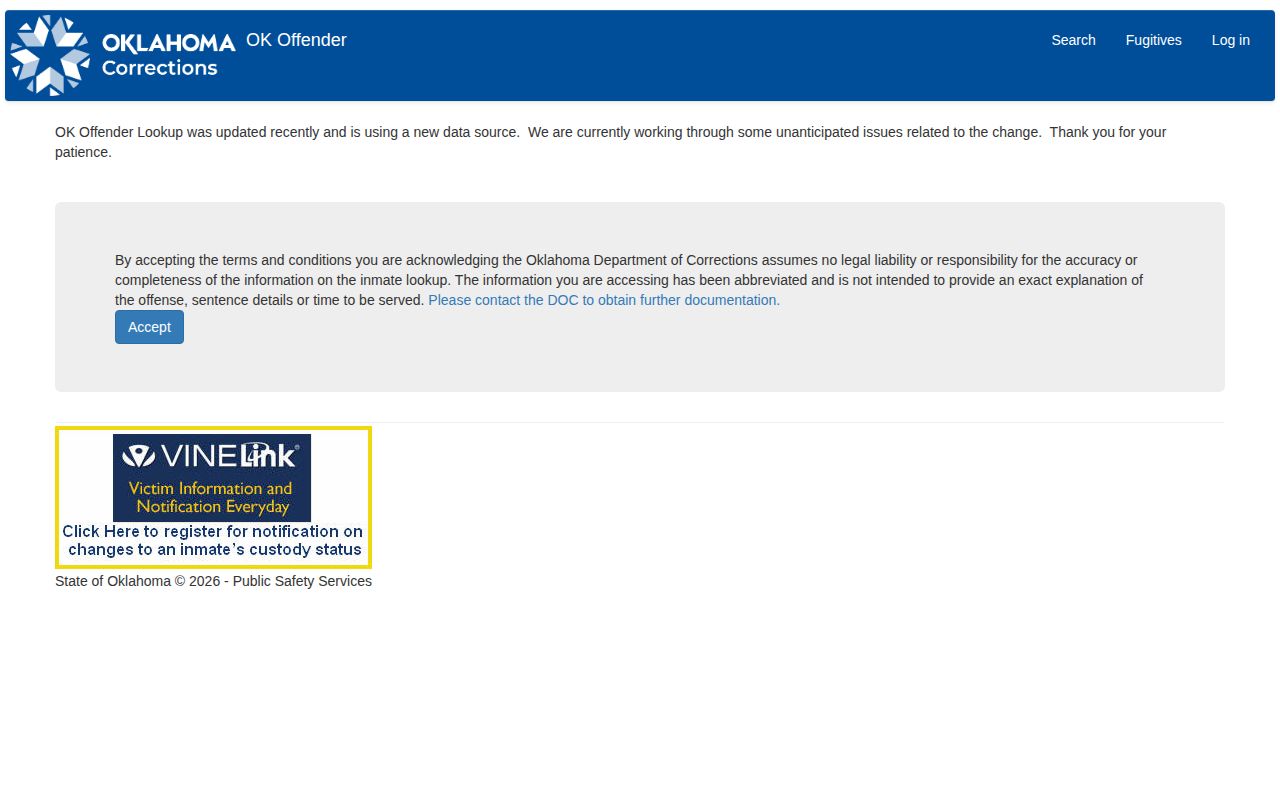
The screenshot documents the agency route without displaying a staged released-person example. The formal release date and type should be taken from the record ODOC owns.
ODOC Offender Release Search Fields
The most reliable search key is the ODOC number. A name can return more than one person, so compare the available identifiers and sentence history. The public lookup may show abbreviated status and sentence information. It can also retain a historical record after a state prisoner has left custody. That persistence is useful when a Cotton County live jail roster no longer shows the person.
Do not promise a public projected release-date field. The official ODOC information gateway says an exact date is confidential unless the inquirer has a legitimate need recognized by the agency. A historical parole or discharge status can guide a records request, but it does not replace the Certificate or CRC. If the person only spent time in Cotton County Jail and never entered ODOC, this state lookup is not the correct release source.
| Search element | Use | Limit |
|---|---|---|
| ODOC number | Best match to a state corrections record | Must still be tied to the right person and sentence |
| Name | Find possible records when the number is unknown | Same-name results require comparison |
| Status history | Identify a possible active, parole, or discharge path | Abbreviated public information |
| Sentence lines | Compare a Cotton County case with the state record | Not an exact explanation of time served |
Save the search time, terms, ODOC number, displayed status, and sentence lines. If the agency later corrects the web entry, that dated note explains what led to the formal request. It should not be used to overstate the earlier screen.
ODOC CRC and Certificate Records
The Consolidated Record Card, form DOC 060211H, is ODOC's working history of sentencing, movement, other cases or detainers, earned and lost credits, modifications, and actions affecting release. A detainer is a notice that another authority may claim custody. For termination, ODOC policy uses distinct notations such as “discharge” with date, “paroled” with date, “death” with date, or “rebill” with date. Read the term literally.
The Certificate of Release, DOC 060211N, is signed by the facility head or probation and parole region. It is also signed and dated by the person, witnessed by staff, and placed in the record. ODOC policy says the released person receives the original and a copy remains in the field file. With the person's consent, their copy can be compared with the agency's record. An unofficial scan should not be described as an agency-certified response.
- CRC
- The ODOC Consolidated Record Card that tracks sentence, movement, credits, detainers, and termination actions.
- Certificate of Release
- The formal ODOC document recording the release action and required signatures.
- Rebill
- An administrative start of a new card for a consecutive case, with custody continuing.
- Discharge
- The recorded end of the sentence component described by the ODOC record.
A discharge to a suspended portion can send the field file to the relevant probation and parole region. That means “discharge” on one component may coexist with community supervision under the Judgment and Sentence. Request the court record when that distinction affects the question.
Cotton County ODOC Transfer Paths
A person can leave Cotton County Jail for ODOC reception. The county jail then records the local departure and destination, while ODOC owns the later state movement and termination history. A county roster no-result should not be converted into a community release claim. Ask the sheriff whether the jail event was a discharge or transfer, then use the named destination.
Historical ODOC reports recorded small numbers of state-offender releases from Cotton County Jail in 2015 and 2017. Those dated facts show why county and state custody can overlap. They do not establish a current county-jail program and should not be used to infer present operations. Current confirmation must come from the Cotton County jail entry and ODOC record for the actual case.
A transfer to ICE is also continued government custody, not community freedom. ODOC policy materials identify an early release to immigration custody as a transfer path. A rebill likewise keeps the person in state custody under a consecutive case. Both examples show why a date needs a release type and destination.
System boundary: Cotton County records the local exit; ODOC records the state sentence path. Obtain both when the person moved from jail to corrections.
ODOC Projected Release Date Limits
ODOC's official offender information page describes the exact release date as confidential absent a legitimate need recognized by the agency. The person receives a monthly days-remaining calculation and may share it voluntarily. Facility records or case-management staff can address the person's own calculation. The public offender lookup should not be presented as offering a confirmed projected date when the research did not verify such a field.
ODOC also calls a projected date tentative. Credit level, misconduct, lost or restored credits, achievement credits, jail-time credit, sentence structure, detainers, and statutory minimums can change the path. A projection is an internal planning estimate. It cannot itself effect discharge or rebill. Final-month actual time and credits control the completed calculation under agency policy.
Parole eligibility, a favorable Board action, a projected date, parole, and discharge are separate milestones. Eligibility means the person may be considered. A Board grant or recommendation is a decision in that process. Parole is conditional community release. Discharge is the termination notation ODOC records. For a past event, request the Certificate and CRC entry instead of reconstructing an old projection.
Note: A projected date that has passed does not prove release; obtain the present custody record and the later termination entry.
ODOC Closed Release Records Contact
ODOC Legal Services lists Closed Records for state discharge inquiries. Use the ODOC open-records portal and describe the exact public record sought. Ask for an estimate before processing. Some corrections or supervision material may require the person's authorization or remain confidential, so request the segregable public portion rather than an unrestricted full file.
ODOC Closed Records
405-425-2691
osor@doc.ok.gov
Discharge-only inquiries: osordischarges@doc.ok.gov
Hours: not published in the reviewed research
A focused request can ask for the publicly releasable Certificate of Release, CRC portions showing parole or discharge date and status, and relevant movement entries. Identify the person and ODOC number, state the Cotton County sentence connection, and name the exact event at issue. If the web search and formal record differ, ask ODOC which record controls and whether a correction process applies.
No fee or response time should be promised without an agency estimate. Public web access, voluntary sharing by the person, an authorized record request, and an official Closed Records response are different access routes. Preserve that distinction when citing the result.
ODOC Supervision After Cotton Release
Parole and some probation or suspended-sentence paths continue under ODOC community supervision after confinement. The Oklahoma Pardon and Parole Board handles parole consideration and decisions, while ODOC administers custody and supervises probationers and parolees. A Board result does not prove the prison exit date. The Certificate and CRC record the custody event, and the assigned office verifies the supervision route to the extent it may disclose it.
Cotton County is listed under the Frederick probation and parole office in neighboring Tillman County. That directory route is locally important, but an individual's residence or placement can change the assigned office. The Cotton County post-release supervision process explains the Frederick contact and the separate fugitive or absconder path.
Supervision and sentence completion are not synonyms. A paroled person remains under conditional sentence terms. A discharge to a suspended portion may begin another supervision component. A fugitive listing indicates an alleged warrant or absconder issue rather than successful completion. Confirm the current status with the office and source record that own it.